
ACL Natural Healing Case Report #51: Severe Ihara Type IV Regenerated to ACLOAS Grade 1 (42-Year-Old Romanian Female)
Summary:
Complete ACL rupture sustained during a gym exercise jump landing. Following a strict consensus rule among three independent specialists, the initial diagnosis was Ihara Type IV—the most severe and complex rupture category. The patient initiated “Evo-Devo Exercise” (Naturalization Therapy) via remote online guidance from Romania. Through rigorous environmental management (30–120° brace ROM restriction / ≤3,000 steps per day) and consistent home exercises 3 times daily, the final MRI achieved a high-quality result: ACLOAS Grade 1 (regeneration with good morphology and continuity). This case demonstrates that high-quality natural ligament regeneration is achievable even through overseas remote treatment by maintaining precise alignment and biological conditions.
ACL Online Therapy for natural healing
The case reports of ACL natural healing
Patient Information
- Age / Nationality: 42-year-old female, Romanian
- Injured side: Left knee
Mechanism of Injury
- Date of injury: 24 April 2023
- Context: Sustained an injury during a jump landing in a gym exercise; knee instability (giving way) was confirmed immediately after the injury.
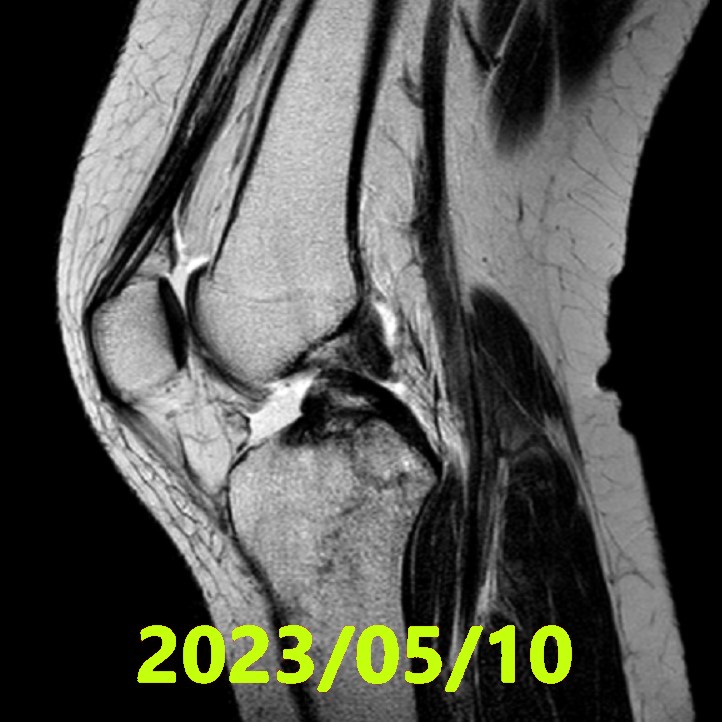
Initial Evaluation (MRI #1)
- Date: 10 May 2023
- Diagnosis: Left knee complete ACL rupture
- Ihara classification: IV (Grade 4) — Confirmed by consensus of 3 independent specialists (most complex rupture)
- Note: After the injury, the patient did not undergo conventional physical therapy but focused entirely on management via the Evo-Devo protocol.
[Ihara classification notes]
I = linear/straight tear; II = curved tear; III = tear with displaced stumps; IV = indistinct/unclear stumps (most complex).
Initial Policy & Start of Therapy
- Start date: 10 May 2023
- Format: Online care at Matsumoto Jun clinic; initiation of Evo-Devo Exercise
- Brace management: Knee range of motion strictly limited to 30–120°
- Activity: Walking restricted to ≤3,000 steps/day
- Home program: Evo-Devo Exercise 3 times/day
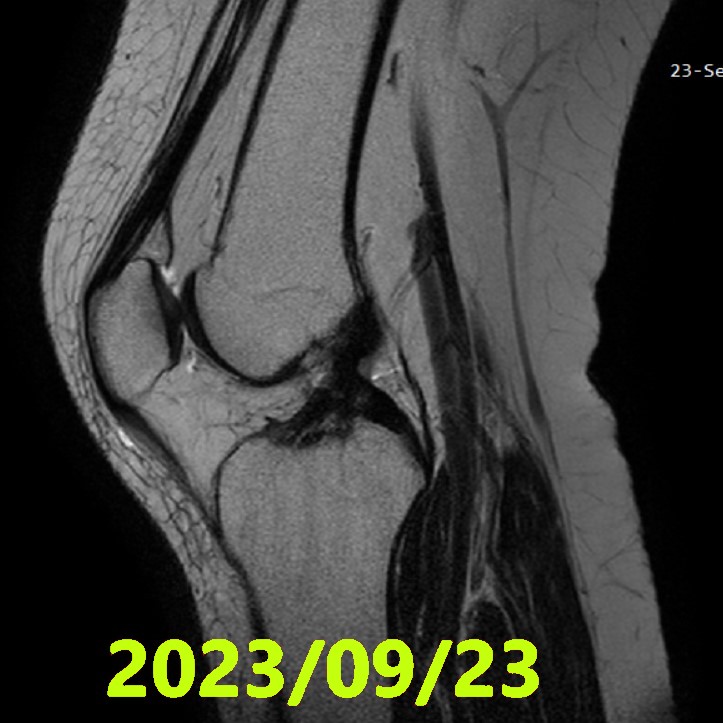
Final MRI Evaluation (~4.5 months)
- Date: 23 September 2023
- Assessment: ACLOAS Grade 1 (good morphology and continuity) — Confirmed by consensus of 3 independent specialists
- Finding: High-quality natural regeneration was achieved, showing clear continuity and signal stabilization of the ligament.
[ACLOAS (native ACL) notes]
0 = normal; 1 = thickening/intra-ligament high signal with shape and continuity preserved (good); 2 = thinning/elongation with continuity preserved; 3 = discontinuity.
Author’s Observations
- Achieving ACLOAS Grade 1 from an initial “Ihara Type IV” (the most severe classification) validates the effectiveness of precise environmental management (30–120° restriction and low step count).
- Despite being a remote case from Romania, the patient’s strict adherence to the principles of Evo-Devo Exercise and avoidance of inappropriate loads led to successful healing.
- The fact that such continuity was restored without conventional physical therapy provides significant hope for patients globally who seek non-surgical options.
Results
- Initial: Ihara IV (consensus by 3 specialists)
- Final: ACLOAS Grade 1 (consensus by 3 specialists) — restored high-quality continuity
- Clinical status: Full return to activities of daily living with excellent stability.
Summary
- Injury (2023/04/24): Left knee complete ACL rupture during a gym jump landing.
- High-quality Regeneration: Achieved a recovery from severe Ihara IV to ACLOAS Grade 1.
- Objective Evidence: The consensus evaluation by 3 independent radiologists serves as vital academic proof of the potential of Evo-Devo Exercise.
References
- Filbay SR, et al. Healing of acute anterior cruciate ligament rupture on MRI and outcomes following non-surgical management with the Cross Bracing Protocol. Br J Sports Med. 2023.
- Ihara H, Kawano T. Influence of Age on Healing Capacity of Acute Tears of the ACL Based on MRI Assessment. J Comput Assist Tomogr. 2017.
- Roemer FW, et al. Anterior Cruciate Ligament OsteoArthritis Score (ACLOAS). Osteoarthritis Cartilage. 2014.