
ACL Natural Healing Case Report #49: Complete Recovery to ACLOAS Grade 1 Confirmed by Three Specialists
Injury while playing badminton: the ACL was completely torn (Ihara Grade III). No surgery was performed. Instead, the patient completed online Evo-Devo Exercise ( avoid full knee extension / ≤3,000 steps per day / home exercises 3 times daily ). Although “ligament laxity” temporarily occurred because the patient initially declined bracing due to work commitments, subsequent strict brace management (0–30°) combined with exercise therapy led to a final MRI result where all three specialists diagnosed ACLOAS Grade 1 (excellent natural healing). The Lachman test became negative, confirming high-quality ligament regeneration.
ACL Online Therapy for natural healing
The case reports of ACL natural healing
Patient Information
- Age / Nationality: 32-year-old male, Japanese
Mechanism of Injury
- Date of injury: 2 May 2023
- Context: While playing badminton, he stepped with his left foot and twisted the knee during a sudden change of direction
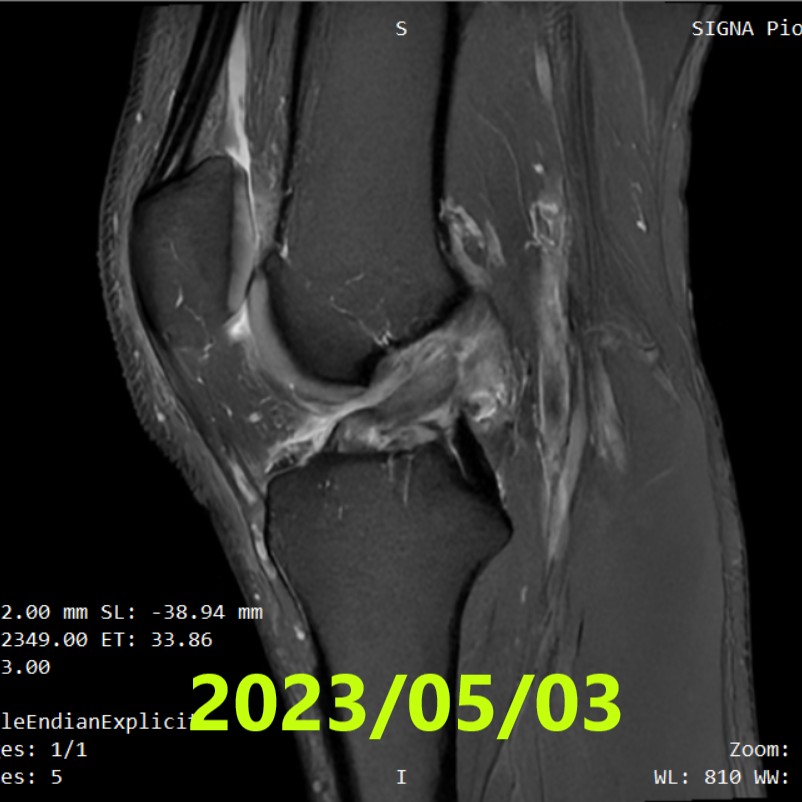
Initial Evaluation (MRI #1)
- Date: 3 May 2023
- Diagnosis: Left knee complete ACL tear
- Ihara classification: III (Grade 3) — Confirmed by 3 independent specialists
- Note: Initially performed conventional physical therapy including full knee extension exercises at a hospital
[Ihara classification notes]
I = linear/straight tear; II = curved tear (simple complete rupture); III = tear with displaced stumps; IV = indistinct/unclear stumps (most complex).
Initial Policy & Start of Therapy
- Start date: 17 May 2023
- Format: Online care at Matsumoto Jun clinic; initiation of Evo-Devo Exercise
- Brace management: knee extension limited to 0–30° (initially declined by the patient due to work)
- Activity: walking allowed up to ≤3,000 steps/day
- Home program: Evo-Devo Exercise 3 times/day
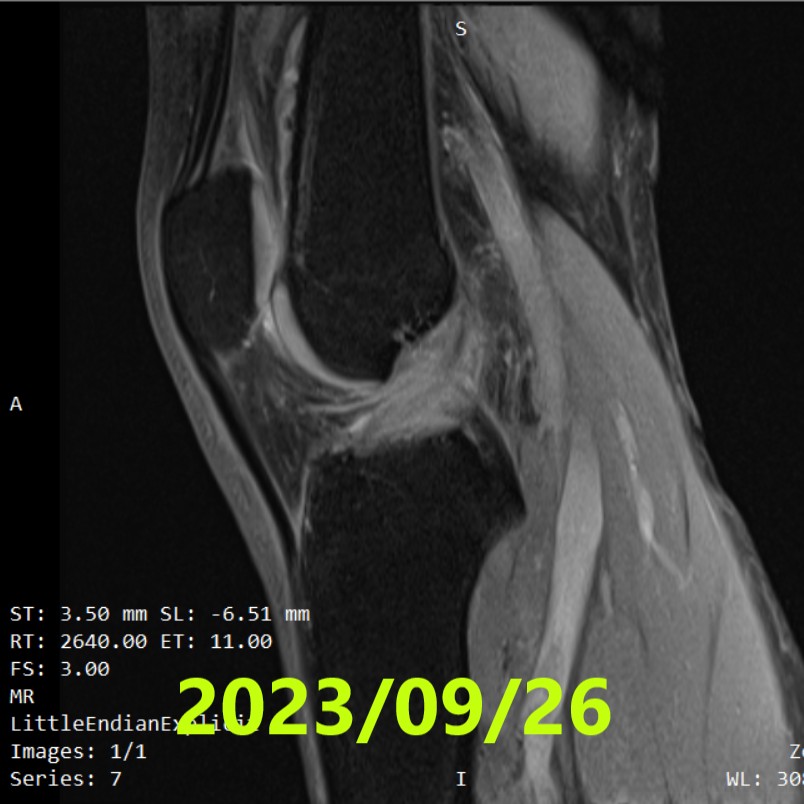
Second MRI (~3 months)
- Date: Late August 2023
- Assessment: Restored continuity confirmed, but ligament laxity (slackness) was observed
- Note: Strict instruction for brace wearing was given after this result to physically limit extension
[ACLOAS (native ACL) notes]
0 = normal (low signal, regular); 1 = thickening/intra-ligament high signal with shape and continuity preserved; 2 = thinning/elongation with continuity preserved; 3 = discontinuity (defect).

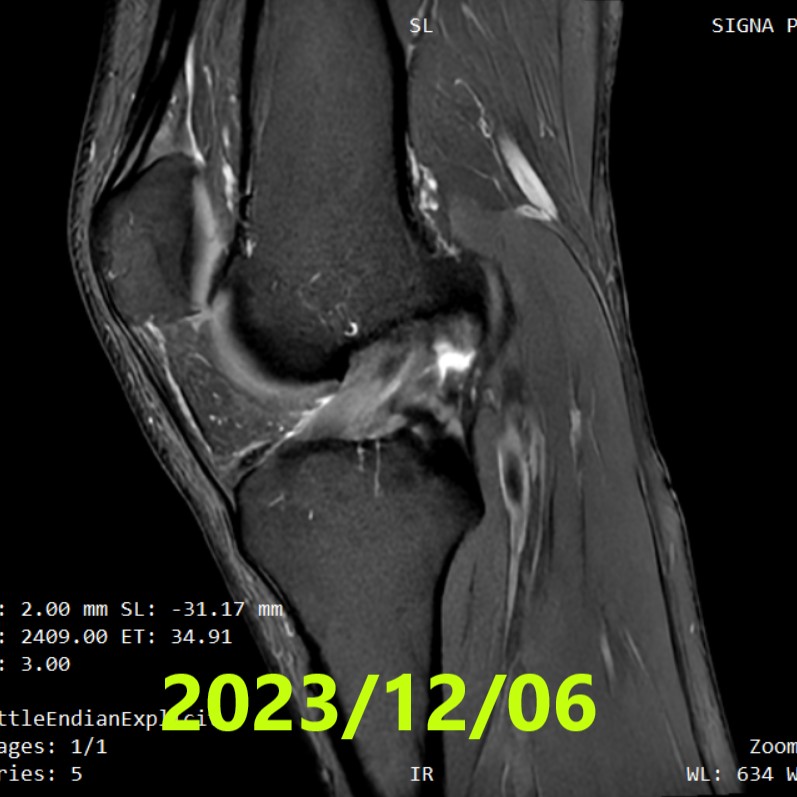
Third MRI (Final Evaluation)
- Date: 6 December 2023
- Findings: Laxity disappeared; the ligament regained excellent tension
- Assessment: ACLOAS Grade 1 (excellent natural healing) — Confirmed by 3 independent specialists
Subsequent Management
- After confirmation of high-quality healing (ACLOAS 1), progressive recovery of full range of motion and strengthening permitted
- Course: Knee stability is extremely good; Lachman test is negative
- Activity level: currently in the rehabilitation phase for returning to sports
Results
- Initial: Ihara III (consensus by 3 specialists)
- ~3 months: continuity restored, but “laxity” remained due to initial lack of bracing
- Final: ACLOAS 1 (consensus by 3 specialists) — restored excellent tension and quality
Summary
- Injury (2023/05/02): left knee complete ACL rupture (twist while playing badminton)
- MRI #1 (2023/05/03): Ihara III — confirmed by 3 independent specialists
- Conservative plan: online Evo-Devo Exercise + brace limiting extension 0–30° + ≤3,000 steps/day
- MRI #2 (2023/08): continuity restored but with “laxity” due to initial compliance issues with bracing
- MRI #3 (2023/12/06): ACLOAS 1 — high-quality natural healing confirmed by 3 specialists
- Outcome: Correcting brace management led to near-normal ligament morphology and excellent stability
References
- Filbay SR, Dowsett M, Jomaa MC, et al. Healing of acute anterior cruciate ligament rupture on MRI and outcomes following non-surgical management with the Cross Bracing Protocol. Br J Sports Med. 2023;57(23):1490–1497.
- Ihara H, Kawano T. Influence of Age on Healing capacity of Acute Tears of the ACL Based on MRI Assessment. J Comput Assist Tomogr. 2017;41(2):206–211.
- Roemer FW, Frobell R, Lohmander LS, et al. Anterior Cruciate Ligament OsteoArthritis Score (ACLOAS): Longitudinal MRI-based whole joint assessment of ACL injury. Osteoarthritis Cartilage. 2014;22(5):668–682.